When a storm knocks out water and sewer service, Kansas City Porta Pros can have standard units on site within hours, not days, with delivery scaled to shelter counts, crew size or a whole displaced block. Standard units run 100 to 350 dollars a day on emergency dispatch, day rate rather than a locked-in monthly term.
Fast is relative to what roads look like, but our default answer is same day when routes are clear, next morning when they are not. Flooding, downed trees and closed bridges around Kansas City change drive times more than distance does, so a delivery that is normally 15 minutes can take an hour. We keep standard porta potty rental units staged and ready to move, because disaster response does not wait for a normal delivery window. If you are coordinating a shelter, a Red Cross site or a church basement turned relief hub, start with emergency porta potty rental rather than a standard quote form, since it routes to dispatch faster.
Sanitation counts still follow OSHA 1926.51(c), which sets 1 toilet for 20 workers or fewer on a jobsite, scaling up from there. Disaster relief crews clearing debris or restoring lines count as workers under that standard, and a displaced household sheltering in a parking lot does not, but we plan for both. For agricultural operations with hand-labor crews sheltering livestock or clearing storm damage, OSHA 1928.110 sets one facility per 20 employees within a quarter mile walk, which matters for farms near farm and agricultural restrooms territory outside the city core. We also lean on how many porta potties do i need to size a shelter fast, and porta potty placement guide to keep units on stable, level ground per ADA Standards 302.1 even when the surrounding lot is a mess.
Water service failures often mean handwashing goes first. A handwashing station rental or portable sink rental covers that gap, and 29 CFR 1910.141(d)(2) requires soap and towels or a hand-drying device at any washing station, not sanitizer alone. That rule does not bend just because the situation is an emergency.
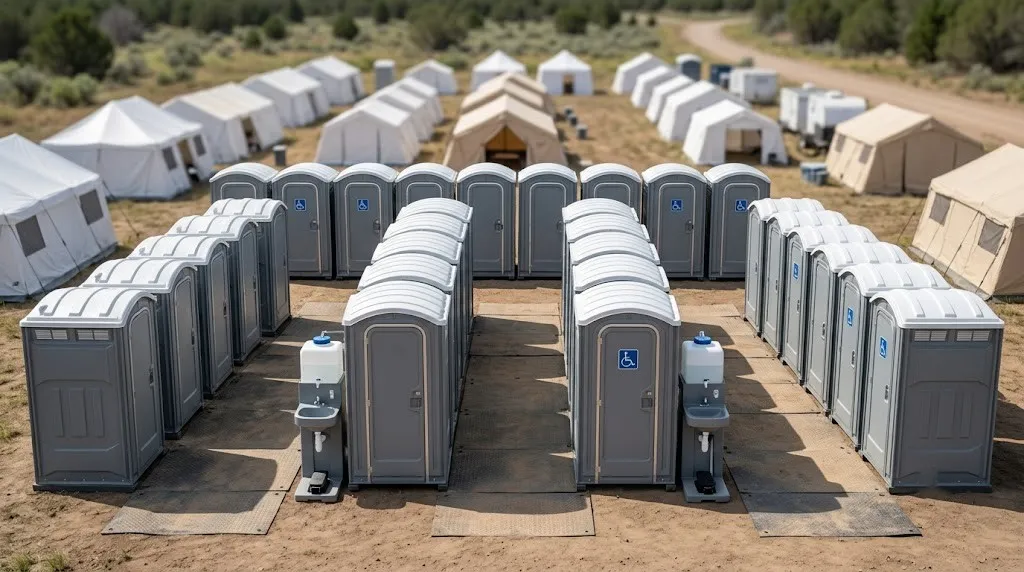
Standard units first, because they deploy fastest and need the least setup. A standard unit holds 60 to 70 gallons and stands about 92 inches tall on a 44 by 48 inch footprint, which fits tight shelter lots and church parking areas without much site prep. If the location has no power and no functioning bathrooms at all, we pair units with a temporary power pole or a light tower rental for overnight visibility, since disaster response often runs past dark.
For longer-term shelter operations, a restroom trailer rental gives displaced families something closer to normal, and an 8 stall restroom trailer handles a larger population than single units can. Debris cleanup generates its own problem: storm waste, wet drywall, downed limbs. A roll-off dumpster rental or construction dumpster rental clears that fast, though a roll-off delivery needs about 60 feet of straight clearance behind the truck, which is worth checking before the truck arrives on a debris-choked street. Flooded septic systems need attention too. A residential tank is typically pumped every 3 to 5 years under normal use, but storm flooding can force an off-cycle pump-out, which falls under septic pumping service or emergency septic service rather than routine maintenance.
Sites without secure storage for donated supplies or equipment can add a storage container rental, and a temporary fence rental keeps a damaged or unsafe structure fenced off, following barricade guidance under OSHA 1926.202.
Yes, and it is not optional just because the situation is urgent. ADA Standards 213.2 requires that where single-user portable units are clustered, at least 5 percent, and never fewer than one, be accessible. Shelters serving elderly residents or people with mobility limitations need an ada accessible porta potty on site from day one, not added later once someone complains. That unit needs a 60 inch turning circle per ADA Standards 304.3.1 and a 32 inch clear door opening under ADA Standards 404.2.3, so placement on firm, level ground matters more than it does for a standard unit. Kansas City relief coordinators working with the Red Cross or a county emergency office should flag accessible unit counts in the initial request, since retrofitting a cluster after delivery costs time nobody has. Full detail lives at ada restroom requirements.
Same-day delivery is typical when roads are passable; storm damage or flooding can push that to the next morning. Dispatch prioritizes shelters, medical staging and crews clearing debris first. Call ahead with a rough headcount so the right mix of standard and accessible units goes out on the first truck.
Yes. North Kansas City sits 2.6 miles northwest, Avondale 4.1 miles north, and Gladstone 8.2 miles north, all within normal response range. Farther towns like Liberty at 15.0 miles northeast or Raytown at 13.6 miles southeast still get service, though drive time depends on storm damage to the route that day.
OSHA 1926.51(c) is written for worksites, not shelters, but it is the closest ratio guide available: 1 toilet per 20 people up to 20, then scaling. For 100 sheltered people, plan for several standard units plus at least one accessible unit under ADA Standards 213.2. Use how many porta potties do i need to size it exactly.
Yes. Flooding can force groundwater into a tank and shorten the normal 3 to 5 year pump cycle significantly. An off-schedule pump-out through emergency septic service prevents backup into the home while other repairs are underway.
A handwashing station or portable sink covers that gap immediately. Under 29 CFR 1910.141(d)(2), the station needs soap and towels or a hand-drying device, since hand sanitizer alone does not meet that requirement. See handwashing station rental for setup options.
Call now or request a free quote — clean units, on-time delivery, transparent pricing.